Nazca Lines
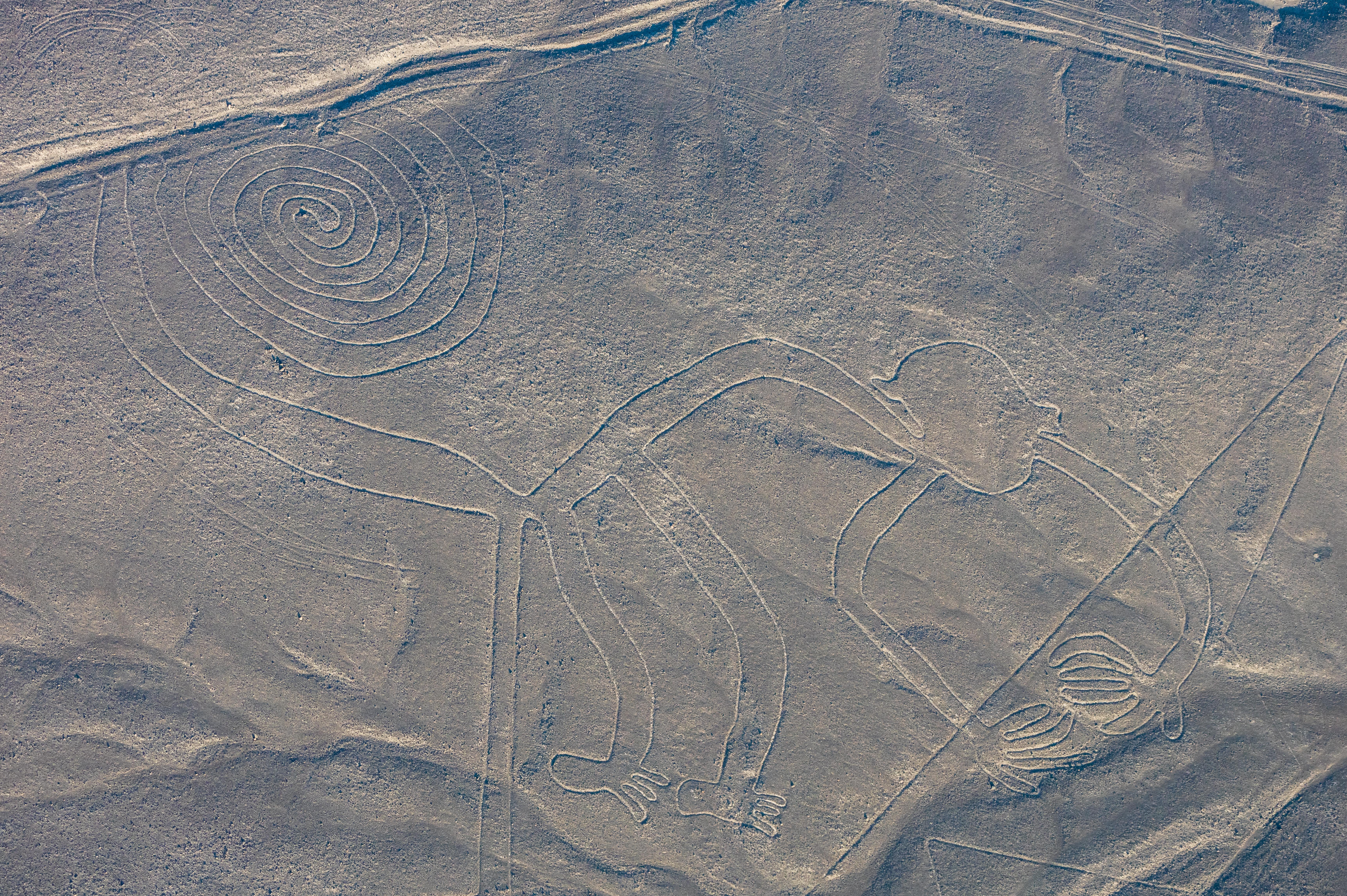
Photo: Diego Delso, CC BY-SA 4.0, via Wikimedia Commons
The Nazca Lines are a collection of over 800 straight lines, 300 geometric figures, and 70 animal and plant designs etched into the desert floor of southern Peru's Nazca Desert. These massive geoglyphs cover an area of nearly 500 square kilometers, with some of the straight lines extending up to 30 kilometers in length. Created by removing the dark iron-oxide coated pebbles from the surface to reveal the lighter-colored earth beneath, the lines have survived for over 1,500 years due to the region's extremely arid climate. The designs range from simple geometric patterns to complex depictions of animals including hummingbirds, spiders, monkeys, and orcas, some measuring up to 200 meters across.
Timeline
Paracas phase begins - earliest geoglyphs created in the Nazca Desert
Nazca phase begins - most famous animal and geometric figures created
Creation of new geoglyphs ceases as Nazca civilization declines
Peruvian archaeologist Toribio Mejía Xesspe first studies the lines systematically
German mathematician Maria Reiche conducts extensive research and preservation efforts
UNESCO designates the Nazca Lines as a World Heritage Site
What the Show Claims
- ›Massive geoglyphs only visible from the air were created as landing strips for alien spacecraftS01E01S05E08
- ›Animal and geometric figures are messages to beings in the skyS01E01S13E05
- ›Nearby Palpa lines may indicate an alien mining operation for nitrate-based rocket fuelS05E08
- ›Maria Reiche's astronomical calendar theory doesn't explain why they need to be so largeS13E05S17E02
- ›Newly discovered geoglyphs continue to be found using satellite imageryS19E19
Theorist Takes
“Whoever comes here in a spaceship, Nazca would be like a beacon, as in: 'Come here.' Because the moment you come to Nazca, you're sort of confronted with a Cliff Notes to planet Earth, where you have all sorts of raw materials that exist in that one particular spot in very, very abundant quantities.”
From the Transcripts
“Also located in Peru are the world-famous Nazca lines. While the origins of these ancient geoglyphs remain a mystery, the area in which the lines are located suggests that a major excavation took place there, perhaps hundreds of centuries ago.”
What Archaeology Says
Archaeological investigations have revealed that the Nazca Lines were created using remarkably simple techniques. The Nazca people removed the dark, iron-oxide coated stones from the desert surface to expose the lighter-colored earth beneath, creating shallow depressions typically only 10-15 centimeters deep. The removed stones were carefully piled along the edges of the lines, creating low borders that helped define the shapes and protect them from wind erosion.
Key researchers have fundamentally shaped our understanding of the lines. Toribio Mejía Xesspe first brought them to academic attention in the 1920s, while German mathematician Maria Reiche dedicated her life to studying and protecting them from the 1940s until her death in 1998. Reiche mapped hundreds of figures and proposed that many served as an astronomical calendar, though this theory remains debated. More recent work by archaeologists like Johny Isla has focused on the cultural context of the lines within Nazca society.
Experimental archaeology has demonstrated that small teams using simple tools - wooden stakes, ropes, and basic surveying techniques - could have created even the largest figures. The lines' remarkable preservation results from the Nazca Desert's unique climate: minimal rainfall, steady temperatures, and little wind create nearly perfect conditions for maintaining surface modifications. Ground-penetrating radar and satellite imagery continue to reveal new geoglyphs, with several hundred discovered in recent decades.
The purpose of the lines remains a subject of scholarly debate. While some clearly point to water sources or have astronomical alignments, the complete function of this vast complex likely involved multiple purposes - ritual processions, water ceremonies, and astronomical observations all probably played roles. The fact that many figures are visible from nearby hillsides challenges the notion that they were designed solely for aerial viewing, though their full-scale impact is certainly most impressive from above.
Mysteries & Fun Facts
The spider geoglyph accurately depicts the reproductive organ of a rare Amazonian arachnid species not native to the coastal desert region
Some of the straight lines maintain their direction with an accuracy of up to 9 meters over distances of several kilometers
The hummingbird figure measures 93 meters from beak to tail, making it one of the largest animal geoglyphs
Several hundred new geoglyphs have been discovered in the 21st century using drone technology and satellite imagery
Planning a Visit
The Nazca Lines are accessible to visitors through several viewing options, including observation towers along the Pan-American Highway and scenic flights from Nazca airport. The most comprehensive way to see the lines is by taking a small aircraft tour, which provides aerial views of the major figures including the famous hummingbird, spider, and monkey geoglyphs.
Nazca, approximately 15 kilometers from the main geoglyphs
The best time to visit is during Peru's dry season from May to September, when clear skies provide optimal visibility for flights and minimal weather disruptions. Early morning flights often offer the clearest atmospheric conditions and best photographic opportunities.
Featured Locations8 sites within this area
Palpa region (flat mountaintops)
PeruEl Astronauto (The Spaceman figure, Nazca)
PeruPalpa region mountaintops
PeruPalpa Geoglyphs
PeruNazca Plateau
PeruAncient Aliens proposes that the geometric patterns and lines at Nazca may have served as landing strips or signals for alien spacecraft. The show emphasizes the impossible scale and precision of the designs when viewed from above.
Nazca Plain, Peru
PeruNazca Sun-Star and Cross glyph, Palpa Valley
PeruNazca Lines, Peru
PeruRelated Sites
Also Covered In
Featured In5 episodes
Historical data sourced from Wikipedia