Petra
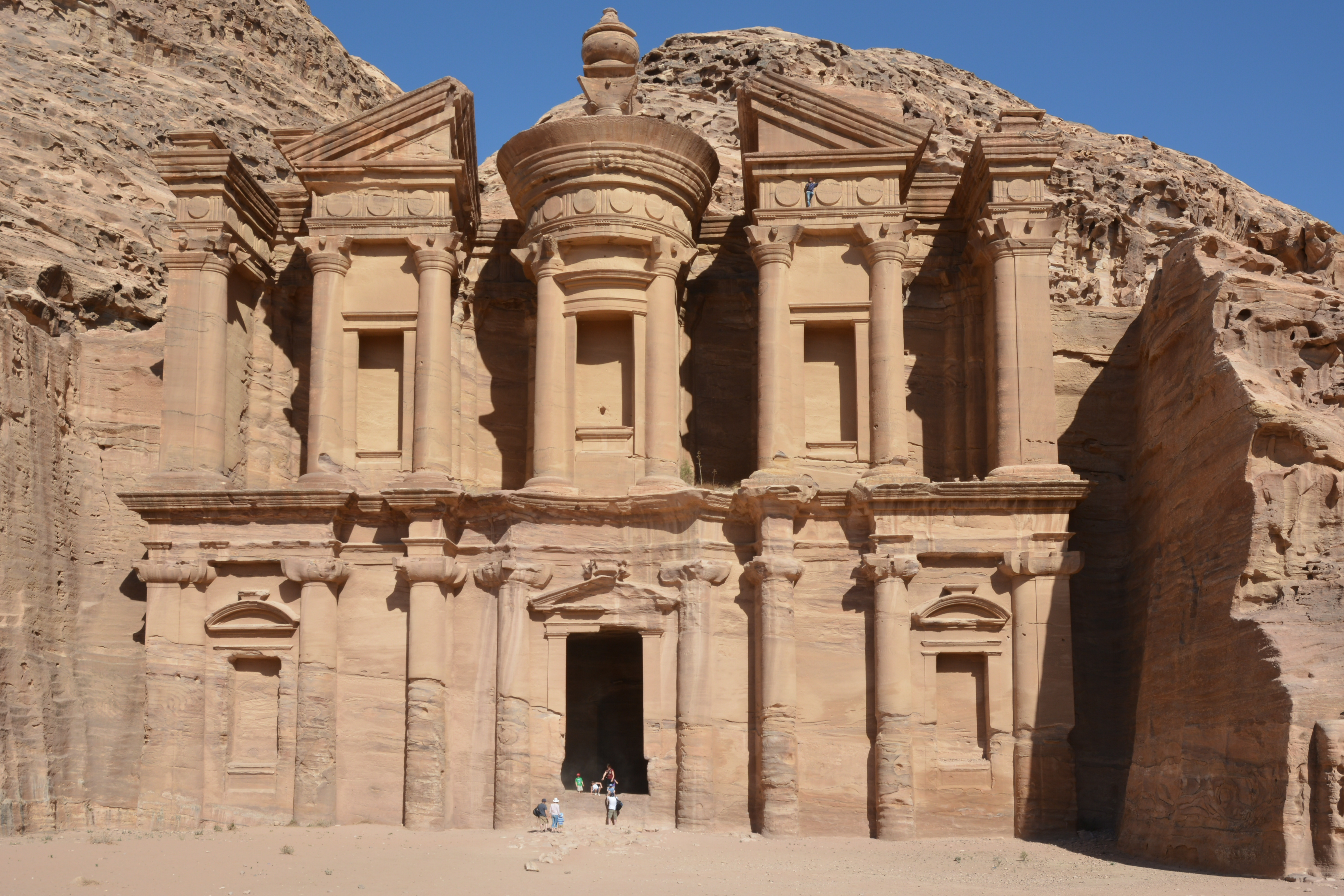
Photo: Azurfrog, CC BY-SA 3.0, via Wikimedia Commons
Petra is a vast archaeological city carved directly into rose-red sandstone cliffs in southern Jordan's desert mountains. The site encompasses over 264 square kilometers and contains more than 800 individual monuments, including the iconic Treasury (Al-Khazneh) facade that soars 40 meters high. Originally known as Raqmu to its Nabataean inhabitants, this "Rose City" served as the flourishing capital of a trading empire that controlled lucrative incense and spice routes between Arabia and the Mediterranean. The dramatic entrance through the narrow Siq gorge, stretching 1.2 kilometers between towering sandstone walls, creates one of archaeology's most breathtaking reveals.
Timeline
Earliest evidence of human habitation in the Petra region
Nabataeans establish settlement and begin developing Petra as a trading hub
Petra becomes capital of the Nabataean Kingdom, major construction period begins
Al-Khazneh Treasury constructed, possibly as mausoleum for King Aretas IV, city reaches peak population of 20,000
Romans annex Nabataean Kingdom, rename it Arabia Petraea
Major earthquake destroys many structures, beginning city's decline
Swiss explorer Johann Ludwig Burckhardt rediscovers Petra for the Western world
UNESCO inscribes Petra as World Heritage Site
What the Show Claims
- ›Treasury and other facades carved directly from cliff faces with impossible precisionS03E03S06E10
- ›Nabataeans had advanced knowledge of water engineeringS03E03
- ›Acoustic properties of the Siq entrance corridor may have ceremonial significanceS03E03
- ›Some researchers suggest alien assistance in carving the elaborate facadesS06E10
From the Transcripts
“The line also encompasses the ancient Sumerian city of Ur; the ruins of Petra, Jordan; and Persepolis, the capital city of ancient Persia.”
What Archaeology Says
Archaeological excavations at Petra have revealed the remarkable sophistication of Nabataean civilization, far from requiring extraterrestrial intervention. The American Center of Oriental Research has led extensive studies showing that the facades were carved using traditional iron tools—chisels, hammers, and picks—whose marks remain clearly visible throughout the site. Teams have documented the step-by-step carving process, beginning from the top and working downward to prevent debris from damaging completed work below.
The Nabataeans' water management system represents one of antiquity's greatest hydraulic engineering achievements, with over 200 cisterns, numerous dams, and an intricate network of channels that could collect and store precious rainfall in this desert environment. Recent archaeological surveys have mapped this system's full extent, revealing how the Nabataeans transformed a harsh landscape into a thriving urban center capable of supporting thousands of inhabitants. The precision of their rock-cutting reflects generations of inherited craftsmanship, not alien technology.
Modern research has also illuminated Petra's role as a cosmopolitan crossroads where Nabataean, Hellenistic, and Roman architectural influences merged. Excavations of residential areas, markets, and religious complexes paint a picture of a wealthy, culturally diverse society that prospered through trade rather than mysterious intervention. However, significant portions of Petra remain unexcavated, and ongoing discoveries continue to refine our understanding of this remarkable civilization's achievements.
Mysteries & Fun Facts
Petra appears in the film Indiana Jones and the Last Crusade as the temple housing the Holy Grail
The site contains over 3,000 tombs, temples, and dwellings carved directly from sandstone cliffs
Nabataeans developed a unique form of Arabic script that represents one of the earliest known forms of Arabic writing
The Treasury's facade shows no evidence of tool marks on its higher sections, achieved through the Nabataeans' top-down carving technique
Planning a Visit
Petra is accessible through the modern town of Wadi Musa, with well-maintained paths leading through the Siq to the main archaeological area. The site requires considerable walking over sometimes uneven terrain, and visitors should plan for a full day to see the major monuments including the Treasury, Royal Tombs, and Monastery.
Amman, approximately 240 kilometers north
March through May and September through November offer the most comfortable weather, avoiding both summer heat and winter rains. Early morning visits provide the best lighting for photography and fewer crowds.
Related Sites
Abu Simbel
Another spectacular example of monumental architecture carved directly from living rock
Lalibela Rock-Hewn Churches
Medieval Ethiopian churches hewn from solid volcanic rock demonstrate similar stone-carving mastery
Kailasa Temple
Massive Hindu temple complex carved from a single rock formation in India
Also Covered In
Featured In2 episodes
Historical data sourced from Wikipedia